
Why Canada Goose Aren’t Leaving Anymore — and What That Means for Your Property
Why Canada Goose Aren’t Leaving Anymore — and What That Means for Your Property
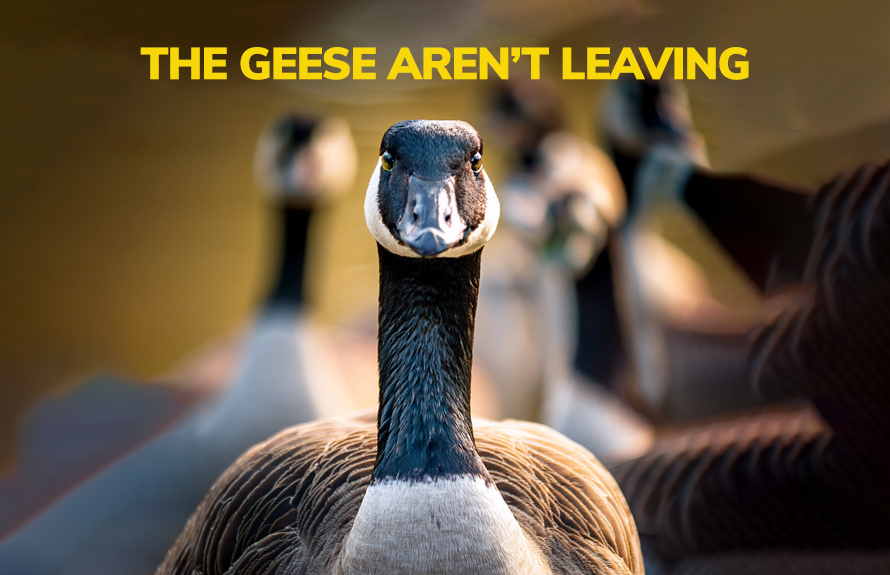
For decades, Canada Goose were known primarily as migratory birds—seasonal visitors that arrived in the Fall and departed in the Spring. But across the Central and Mid-Atlantic regions, that pattern has changed dramatically. Today, a growing number of Canada Goose have become year-round residents, creating persistent challenges that require more advanced goose control strategies for property owners, facility managers, and municipalities alike.
Wildlife researchers have been tracking this shift for years. Studies show that resident Canada Goose now make up the majority of the total population1, rising significantly over the past several decades. What’s driving this change? In large part, it’s the environments we’ve created. Suburban and commercial landscapes—with manicured lawns, retention ponds, office parks, and golf courses—offer the perfect combination of food, water, and safety, making them ideal habitats for geese to settle permanently.
Unlike migratory geese, resident populations don’t face the same natural pressures. They avoid the risks of long-distance travel and harsh climates, allowing them to thrive and reproduce locally. As a result, these geese tend to stay in one place year-round, returning to the same properties season after season—often in growing numbers. This makes effective goose control not just a seasonal concern, but an ongoing necessity for many organizations.
The Impact to You
The impact is becoming more noticeable across business parks, apartment communities, schools, and recreational facilities throughout the eastern United States. Large populations of resident geese can affect property appearance, safety, and water quality, while also creating liability concerns due to aggressive behavior during nesting seasons. For many organizations, these challenges have led to increased demand for professional geese removal solutions that are both humane and effective.
The difficulty is that once geese establish a property as their home, they are extremely resistant to change. Traditional deterrents—such as noise devices, visual scare tactics, or occasional interventions—may provide temporary relief, but geese quickly adapt. Sustainable goose control requires a consistent, behavior-based approach that discourages geese from returning in the first place.
The Humane (and Effective) Solution
That’s where specially trained Border Collies offer a proven solution. As a form of professional geese removal, these dogs naturally and humanely mimic predators, creating a safe but persistent disruption that geese instinctively avoid. Over time, this method retrains geese to see a property as unsafe, encouraging them to relocate elsewhere—without harm. It’s an environmentally responsible approach to goose control that delivers long-term results where other methods fall short.
Interested in our approach to goose control? Contact us for more information and a free quote.
1 “Population Trends of Resident and Migratory Canada Geese in Relation To Strikes with Civil Aircraft” Richard A. Dolbeer, John L. Seubert, Michael J. Begier, 2014