Want to get rid of a goose? Take a gander at these border collies

Want to get rid of a goose? Take a gander at these border collies

from The Times

After Bob Young acquired a puppy named Boomer, he arrived home each evening to find that the dog had spent the day tearing up his house.

Boomer was a border collie. “His grandfather was from the Scottish Highlands,” said Young. He had been born on a dairy farm in Pennsylvania. But now he lived in the suburbs of New Jersey, far from the madding cow, or the disordered sheep. Then Young heard of a new line of work that was opening up for under-employed border collies like Boomer. They were needed to chase Canada geese.

Young is now the proprietor of Geese Chasers, a company based in New Jersey with franchised offices all over the United States, sending out border collies to drive geese from golf courses, lawns and parks.
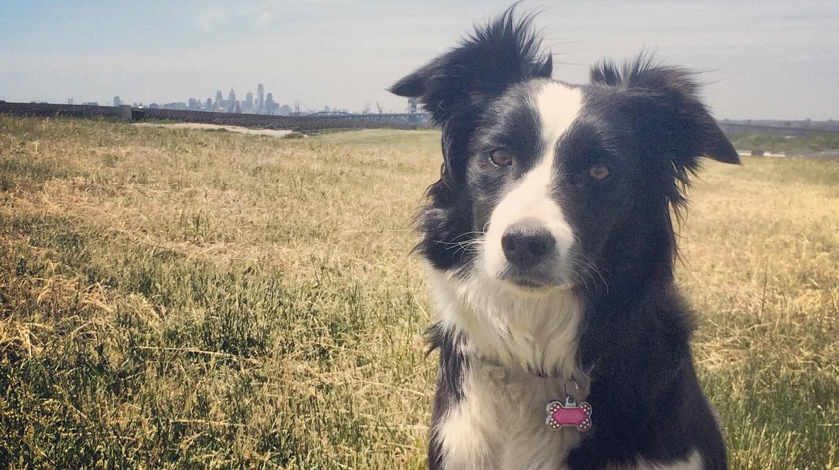
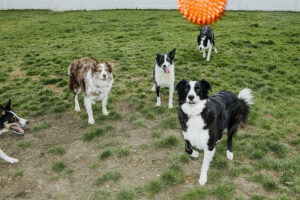
A company called Geese Chasers sends out the dogs to drive the birds from golf courses, lawns and parks

In Connecticut, a rival company deploys 12 border collies, all raised in the kennels of a sheepdog trainer in North Carolina. “All our dogs are trained with traditional sheep-herding commands,” said Chris Santopietro, 57, the proprietor. “Basically you are substituting the sheep with geese. They’re not touching or harming the geese. We are introducing what [the geese] think is a predator.”

Geese chasing is a growth industry, thanks to a bird that has turned, in the space of about half a century, from an apparently threatened creature into an all-conquering invader of lawns and parklands across the country. An act protecting migratory birds ensured its safety and from 1970 to 2010 its numbers are estimated to have increased from a quarter of a million, to 3.5 million, even as new acres of geese-friendly territory are laid in America’s suburbs.

“Every time they build a corporate park, they have a pond for run-off,” Santopietro said. “They are nicely landscaped, with plenty of green grass for the geese to eat.”

Cemeteries, municipal parks, football fields and golf courses are also perfect goose habitats, but the birds do not treat them kindly. They tear the grass up, they drive off other birds and they leave large droppings that carry bacteria including E. coli.

“Each goose averages two pounds of droppings a day,” Santopietro said.

In The Anthropocene Reviewed, the writer John Green devotes a chapter to Canada geese as a creature of the suburbs, a native of man-made landscapes. “The world contains between four and five million Canada geese, although from where I’m sitting in Indianapolis, that estimate seems low, as there appear to be four or five million just in my backyard,” he writes. He said they lived in urban areas at roughly the same ratio (3:1) as American humans. Whatever else you did, “you, as an individual, can’t do much about the Canada goose,” he wrote.

He had clearly not heard of the goose-dog. Santopietro said that border collies appeared to the birds like arctic foxes or coyotes and when the birds fled for the safety of a pond, the dogs would follow them into the water, ensuring that they left the area entirely.

Young, of Geese Chasers, said he was throwing a ball for Boomer, his border collie pup, trying in vain to tire the dog out, when a passer-by, the proprietor of a local golf course, stopped and said: “Is that a border collie? He said: ‘You don’t see many around any more,’ ” Young said. “I said: ‘Yes there is a good reason for it. They will drive you nuts. They are working dogs. I don’t have anything for this dog to do.’ He said: ‘Well, my course is overrun with Canada geese.’ ”

He suggested that Young bring his dog to the course and let him chase geese. Young, who worked in orthopaedic surgery as a physician’s assistant, began doing that after work. Sitting with Boomer by the 18th hole one day, a former American footballer asked to hire the pair of them to clear geese from his garden that was set around a lake. They “were costing him about $20,000 a year in damage to his property,” Young said.

Boomer, whom Young regards as the founder of his company, died in 2008. “Still think about the ol’ boy every day,” he said. The American footballer remains a client. A dog and handler from Geese Chasers patrol his property daily, and he can summon them at any time if he sees a goose on his lawn.
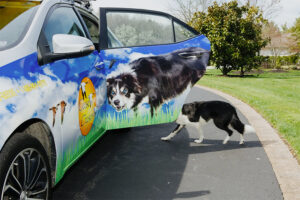
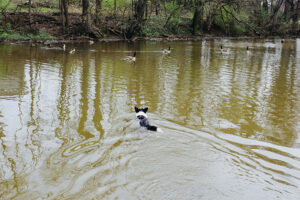
 

His Business? Hiring and Managing Dogs to Chase Geese.

His Business? Hiring and Managing Dogs to Chase Geese.

Robert Young explains how the birds can be a menace and why Border Collies are his star employees.

from The New York Times

In 1998, Robert Young and his dog, Boomer, were visiting a golf course in New Jersey when a man asked Mr. Young for his business card.

Mr. Young, a physician assistant at the time, handed him a card for orthopedic work, but the man was confused. “He just kind of looked at my card and he goes, ‘Don’t you chase geese for a living?’” Mr. Young said.

At this point, Mr. Young looked down at Boomer. His Border collie had chased gaggles of honking, excreting Canada geese from the course just minutes earlier.

And hence, his new business Geese Chasers — one of many goose-chasing businesses across the country — was born.

The company, which Mr. Young runs with his wife, Deborah Young, now has a presence in 10 states and hundreds of towns and cities, including New York City, where a dog can sometimes be spotted clearing Central Park. The following interview is an edited and condensed version of a conversation with Mr. Young.

According to Birdlife International, the number of geese has increased by 1,500 percent in North America over the last 40 years. Why?

Geese migrate south from the Arctic Circle and Canada in the winter. Their primary food source is grass, and it gets covered up by snow. They have to go south to find areas of barren land that don’t have snow. Winters have not been harsh in much of the United States, so they’ve kind of dug in and call it home now, and they’re really moving around from feeding spot to feeding spot locally. It’s estimated by the federal government that the Canada goose population in this country increases annually by 15 to 20 percent.

Tink gets into the car after his gig. (Photo: Michael Gustafson for The New York Times)

What kind of flight pattern do they follow?

Where we sit is called the Atlantic Flyway. But you also have the Mississippi Flyway, and I think they call the one in the Northwest the Rocky Mountain Flyway, which is probably less traveled, I’d say. But we get calls from Scottsdale, San Francisco, Palm Springs, places you would never think would have a goose problem. They’re everywhere. They acclimate really well. If they have a good food source, plenty of fresh cut grass and plenty of bodies of water, which a lot of these homeowners associations and commercial properties build — you know, the ponds and everything for runoff and also for aesthetics — they’ve got the perfect habitat.

Is it just the excrement left behind by the geese that your clients dislike?

Well, they tear up landscapes. When they eat grass, they pull it up by the roots, and what they leave behind in their feces is very acidic, and that changes the pH of the soil. So only hardened weeds grow on the spot. They do a lot of damage quickly.

Describe the perfect goose habitat. What are the components?

A wide-open field with fresh-cut grass that gives them really good sight lines, so they can see a predator coming. There’s usually one or two lookouts that stick their necks out and look around for predators while the others are feeding. They’re really smart animals. They’re also looking for a nice body of water that they can either fly into or swim into or bring their babies into.

“Border collies need stimulation every day. They’re working dogs,” Mr. Young said. (Photo: Michael Gustafson for The New York Times)

So that means parks and gated communities. What else?

Oh, jeez — you name it. In New York and Jersey City, we have a lot of properties right along the Hudson, where the Sully plane went down. Bird strikes in general occur many times annually and globally to commercial and private aircraft. It is not only geese but anything with feathers that flies.

But the geese must come right back.

We did a study many years ago where we tracked them over 12 weeks. We found that after two chases they stay away for two weeks. If you chase them four times, they stay away for four weeks.

Why are dogs — Border collies in particular — best for the job?

Grounds for Sculpture had us in over the summer. They were excited to bring us in because of our humane methods. Sometimes the federal government will come in and gas the geese. You can hire the U.S.D.A. You just fill out an application and get a proposal for an estimate, and they’ll come one day and round them up and put them in gas chambers and suck the oxygen out of their lungs. It’s disturbing. If you go on PETA, you’ll see they endorse our methods. Highly trained Border collies are the best option.

As for the kind of dog, I did a lot of trial and error in the beginning. I tried Australian shepherds, Labs. The geese weren’t afraid of them. Border collies mimic arctic foxes, which are their only natural predators. An Arctic fox looks exactly like a Border collie.

(Photo by Michael Gustafson for The New York Times)

(Photo by Michael Gustafson for The New York Times)

(Photo by Michael Gustafson for The New York Times)

That’s something you found out by accident.

I learned the hard way. I’m really allergic to dogs, but the minute my son opened his eyes, let me tell you something, he wanted one. Border collies need stimulation every day. They’re working dogs. We had a lake behind our house, and Boomer was chasing everything with a feather out of it, ducks, cormorants, anything that moved. When he finally chased the last duck out, he’d come out almost passed out and he’d be ready to do it all over again. I would say, “You’re nuts, dog.”

That’s when you started bringing him to the golf course?

One day the owner of the country club told me he’d been reading about a golf course in the Midwest that had used Border collies to get rid of geese effectively. He said there were 500 birds on his course and so much poop that they couldn’t play golf. Then he asked, “Do you think that dog will chase them?” On the first day, Boomer took off like a shot. He knew exactly where to go. Next thing you know, the entire sky is filled with geese. Then he jumped into a gigantic pond like Superdog.

And that’s where you got your first paying gig, with the golfer who asked for your business card?

Mike. To this day, he’s a client. I told him I would never raise the price on him. We still keep his property clear for 99 bucks a week. Now it would run him three or four times that.

The dogs are smart and love activity, Mr. Young said. “People get really happy when they see the dogs and understand we’re giving them a great life, where they can run every day.” (Photo: Michael Gustafson for The New York Times)

It must get expensive to clear a place like Central Park. Do you need a pack of Border collies to remove geese from such a huge area?

No, no. It’s only one or two dogs. These are independent working dogs. I tell my franchisers, when you get two really good working dogs together, they’re so stinking smart that one dog might say to himself, ‘Why should I go out there when he can do the job without me?’ For Central Park, they’ll get there maybe at 7 a.m., and I think they stay only a couple of hours and they’re out by 9 or 9:30.

How do people respond when you tell them you chase geese for a living?

My parents thought I was going to be put in a mental institution. But people get really happy when they see the dogs and understand we’re giving them a great life, where they can run every day. People have seen me sitting in the car with the dog and they’ll go, “You’ve got the best job in the world! You get to work with your best friend every day.”

Meet Bob Young, South Jersey man who stumbled into service that municipalities, country clubs and others are thrilled to have found — and can’t do without

Owners say this is crucial season when geese have their offspring

from ROI NJ

Bob Young will be the first to admit it: When he was a surgical physician’s assistant at a knee and shoulder center in South Jersey in the 1990s, he didn’t care much for the job.

“I couldn’t stand medicine; I couldn’t stand patient care,” he said. “I did it to support my family and make a better life for us.”

He also didn’t care much for dogs.

“I was allergic,” he said.

His young son, however, loved them. Lived and breathed for them, Young said. That’s why Young got his son a border collie named Boomer, the first step in a series of events that changed his life.

And at first, it wasn’t for the better.

Young didn’t know border collies were working dogs. He just knew when he got home from a job he didn’t particularly like, he had to take Boomer and son out to play — or risk having his house torn apart.

“Boomer was chewing through our walls, our furniture, the floorboards — everything,” he said. “I’d take him out and throw a ball or frisbee every day at the church field right around the corner from our house. I had to run him around and wear him out.”

One day, while playing fetch, a car pulled up — and out stepped someone from nearby Ramblewood Country Club.

He asked if Young would bring his border collie to the country club to chase the Canada geese away. 

Young didn’t know that border collies had been known to chase geese — that they mimic the arctic fox, the only natural predator a Canada goose has. He didn’t know that other courses around the country were starting to use them for this purpose.

He just knew the man was promising free golf for him and free lessons for his son. So, he was happy to come to the club.

Boomer immediately took to the visit — chasing Canada geese out of the ponds and off the course. While doing so, he drew the attention of one of the club members.

“He asked what I charge to chase geese out of a neighborhood,” Young said. 

With that, the entrepreneurial light went on.

By 2002, Young had enough clients and enough courage to open his own business. Twenty years later, Mount Laurel-based Geese Chasers — and its two franchisees in the state — are servicing nearly 300 clients. And that’s just in New Jersey. 

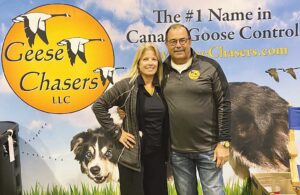
Bob Young, above right, CEO, with his wife, Deborah Young, the chief operating officer of Mount Laurel-based Geese Chasers.

Through franchising, Geese Chasers is doing business in eight other states, including New York, Pennsylvania, Delaware and Maryland — as far south as North Carolina and as far west as Illinois.

“And, we’re just getting started,” Young said.

That’s what brought Young, the CEO, his wife Deborah Young, the chief operating officer, and the owners of the North Jersey franchise, Brooke Bello and Joseph Bello, to the recent League of Municipalities event in Atlantic City.

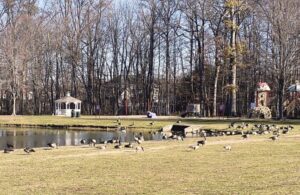
A park in Morris Township in need of geese control. ­(Tom Bergeron)

Municipalities are one of the company’s core customers, joining country clubs, universities, private and commercial properties and sports teams (Geese Chasers has a contract with the New York Red Bulls — and used to service the Philadelphia Eagles).

Here’s how it works.

Geese Chasers has more than a dozen border collies in New Jersey. How they are used — and how often they are used — depends on the client’s needs, Young said.

The size of the property is one key. More important may be the number of ponds you have.

Young said Geese Chasers may come daily in the opening weeks, but then shift to 1-2 times a week as needed — and always on call, as needed, he said.

The dogs can come throughout the day, depending on when there is the fewest number of people on the property.

And, while Geese Chasers operates year-around (most clients are on yearly contracts), Brooke Bello said one key is to make sure you’re on board by mid-February to mid-March, when the geese have their offspring.

The price for the service is based on all of the factors above — with contracts as low as $250 a month to as high as $4,500, Young said.

###

Young has a quick wit and is media savvy. He should be: His company has been featured on dozens of media outlets in the past two decades. That’s why he has sound-bite ready answers to the two most obvious questions:

Q: Do the geese go away for good?

A: Nope. Just like your grass, they always come back. That’s why we have maintenance plans.

Q: Where do the geese go?

A: Hopefully, to our next customer.

The team feels it got a few new customers at the League of Municipalities event. Deborah Young said each day at the event’s expo brought a few dozen solid leads.

Bob Young said the interest shows him that, 20 years later, there still is a strong need for his services — and a strong desire for a business he stumbled into by accident. 

He laughs at his good fortune.

“No kid has ever said, ‘Hey, mom, I want to chase geese for a living,’” he joked. “But that’s what we do, and we love it.”